
Background
A precision parts manufacturer running a lights-out production shift needed to integrate leak testing into an existing fully automated assembly line without adding a standalone instrument station or a dedicated operator. The leak test step sat between a robotic assembly cell and a packaging conveyor — both operated unmanned for 8-hour overnight shifts.
Requirements: leak test module must fit inside the existing Rittal control cabinet (300 mm depth available), accept PLC trigger and output OK/NG to the robot controller, log every result with part serial number to the plant MES, and raise an alarm relay after 3 consecutive NG results to halt the line without operator presence.
Integration Requirements
| Requirement | Specification |
|---|---|
| Physical form factor | Fit inside 300 mm depth Rittal cabinet, DIN-rail mountable |
| Power | 24 VDC from cabinet power supply |
| PLC interface | Siemens S7-1200 via PROFINET |
| Test trigger | PLC START signal, robot confirms part loaded |
| Result output | OK/NG digital output to robot controller + PROFINET data to PLC |
| Data logging | Per-unit: serial number (from barcode), pressure value, OK/NG, timestamp → MES via Ethernet |
| Consecutive NG alarm | Relay output after 3 consecutive NG — halts conveyor, triggers warning beacon |
| Unmanned duration | 8-hour overnight shift, no operator access |
Solution
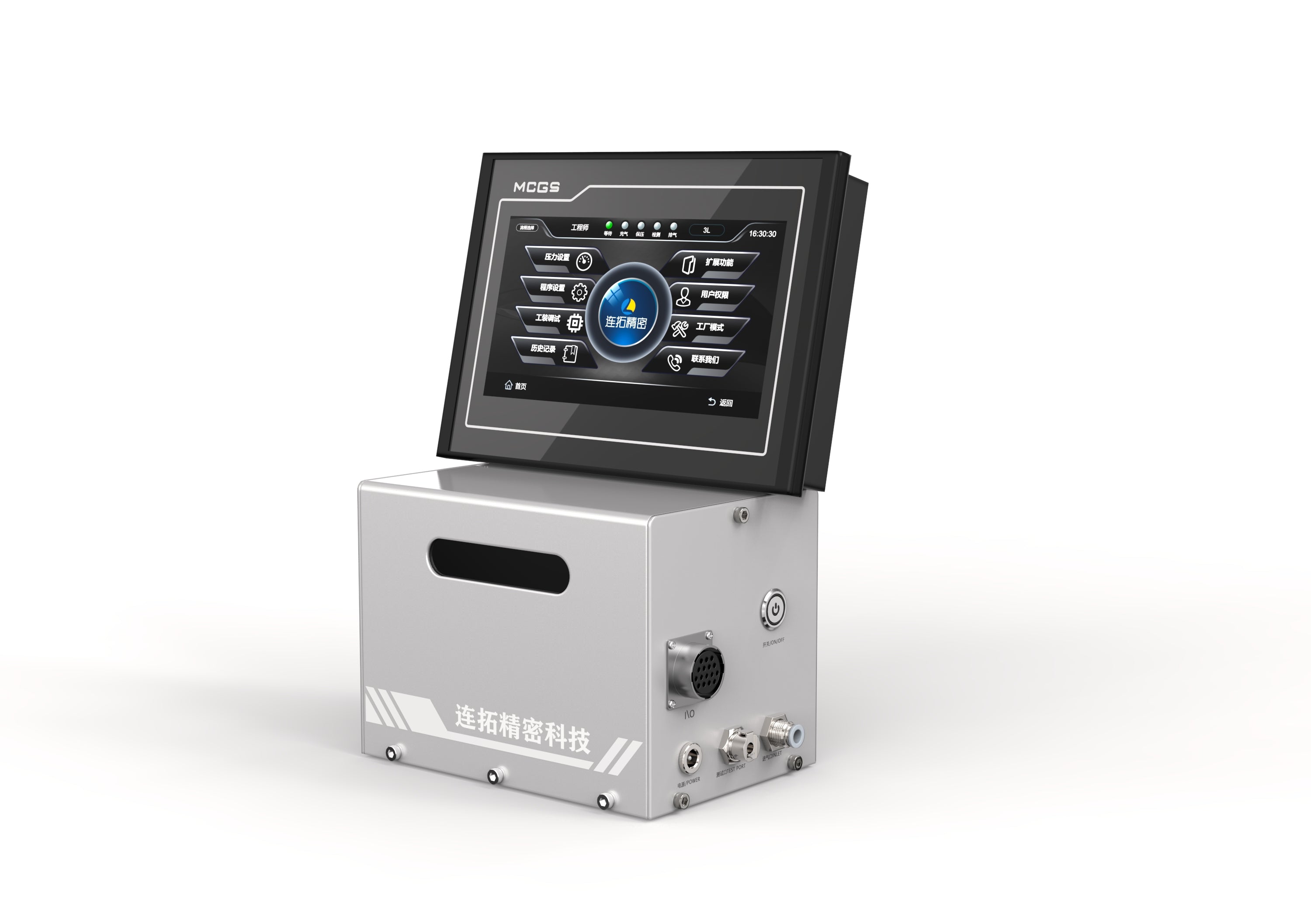
Figurtech deployed an LE Series embedded module mounted on DIN rail inside the existing cabinet. The LE's 99 × 180 × 200 mm footprint fit within the available 300 mm cabinet depth with clearance for pneumatic tubing. A 24 VDC adapter was provided to interface with the existing cabinet power bus.
PROFINET integration with the Siemens S7-1200 handled cycle trigger, status, and result data. The PLC sends a START command when the robot confirms part-present, the LE executes a 4-stage test cycle, and returns OK/NG + pressure value via PROFINET within 18 seconds. The PLC forwards the result to the robot for downstream sort decision.
A 2D barcode reader mounted on the cabinet door reads the part serial number at robot load — the serial number, pressure trace, OK/NG, and timestamp are formatted as JSON and sent to the plant MES via Ethernet at the end of each cycle. A consecutive-NG counter in the LE activates a relay output (and cabinet beacon light) if 3 NG results occur in sequence — the PLC uses this signal to halt the conveyor and queue a maintenance alert.
Results After Deployment
- Zero additional floor space — module fits entirely within existing cabinet
- Unmanned operation: 8-hour overnight shifts, zero operator interventions required
- MES traceability: 100% per-unit records from first production shift
- Consecutive-NG alarm triggered twice in first 6 months — both were genuine fixture seating faults caught before producing more than 3 NG units
- Cycle time: 18 s including PROFINET handshake — within 20 s line cycle
- Line availability: 99.2% over 6-month operating period
Instruments Used
- LE Series Embedded Leak Test Module — 99×180×200 mm, PROFINET, 24 VDC compatible, DIN-rail mount, consecutive-NG alarm relay
- Custom pneumatic fixture mounted on robot end-of-arm tooling interface plate
- 2D barcode reader (USB) for serial number capture at load
- Rittal cabinet integration: DIN-rail mount, 24 VDC, PROFINET, Ethernet, relay wiring
Integrating leak testing into an unmanned cabinet or robotic cell? Share your PLC type, cabinet dimensions, cycle time, and MES protocol — we will provide a complete integration proposal.
Request an Engineering Evaluation →