
Background
A camera module manufacturer producing modules for smartphones and automotive ADAS systems needed to add inline airtightness validation to a high-speed assembly conveyor. The modules used UV-cured adhesive seals bonding the lens barrel to the sensor housing — a seal that could fail subtly, causing slow moisture ingress and lens fogging in the field.
The challenge: module internal volume was approximately 0.4 mL (sub-milliliter), the production conveyor ran at 1,800 units per hour per lane, and the test station needed to validate four modules per fixture load without becoming a throughput bottleneck. Fixture contact could not apply force to the optical axis or lens surface.
Test Requirements
| Parameter | Specification |
|---|---|
| Part | Smartphone camera module, UV-adhesive sealed, ~0.4 mL internal volume |
| Test method | Direct pressure airtightness |
| Test pressure | 20 kPa |
| Leak limit | ≤ 0.03 kPa pressure drop over 8 s dwell |
| Channels | 4 simultaneous, independent result per module |
| Cycle time | ≤ 12 s (fill + stabilize + measure + exhaust) |
| Repeatability target | ±0.5% across 4 channels and across shifts |
| Fixture constraint | No force on lens surface or optical axis |
Solution
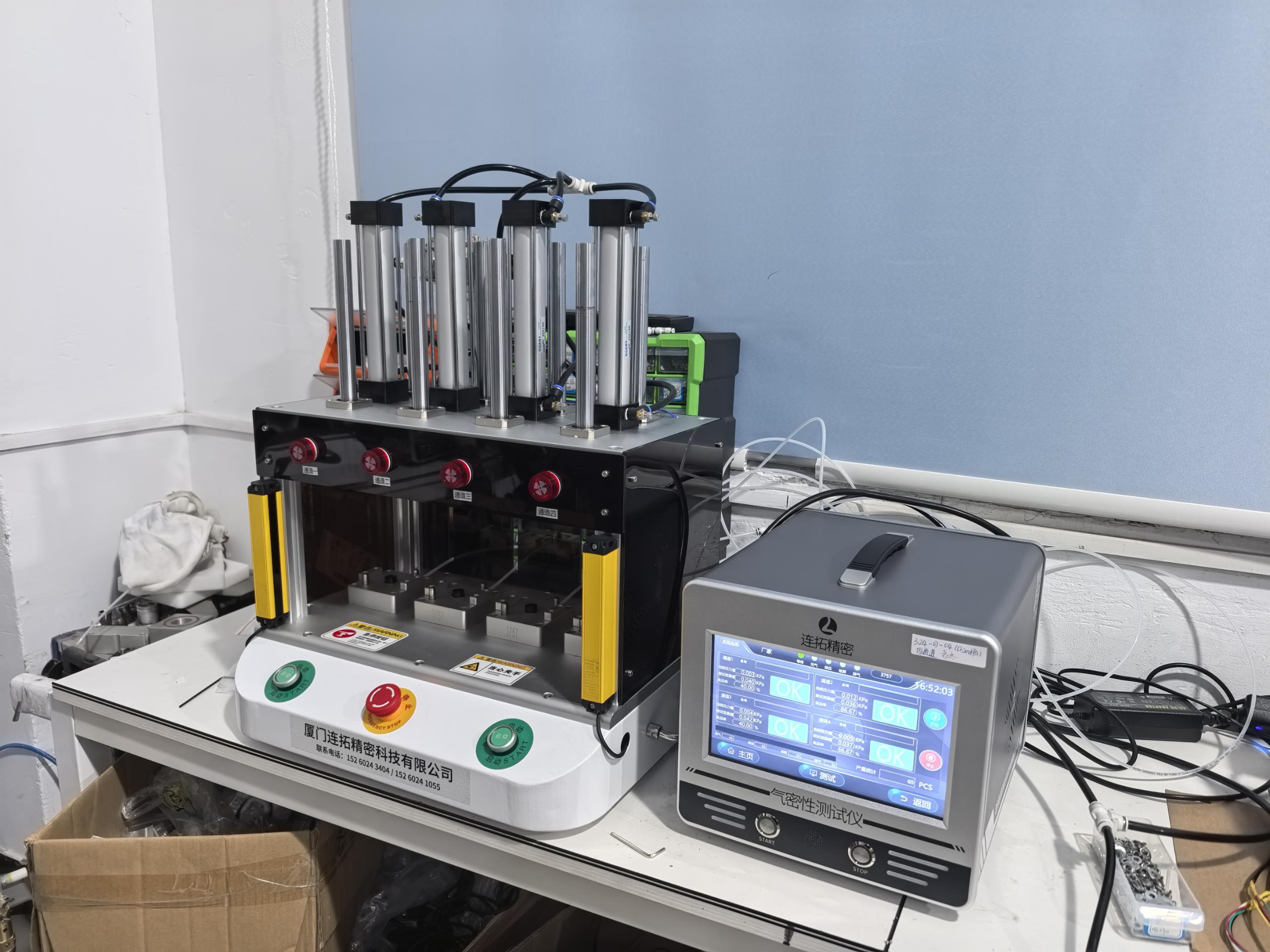
An LM Series 4-channel instrument was paired with a custom micro-volume fixture nest. The fixture contacts the module only on its metal housing perimeter, using a soft silicone O-ring on each nest position. The O-ring creates a sealed air volume around each module without applying axial load. Nest volume was minimized to 0.6 mL total (module + fixture dead volume) to maximize pressure sensitivity at 20 kPa.
All four channels on the LM instrument run identical independent measurement paths — separate sensor, separate solenoid valve set — with no shared pneumatic circuit. This eliminates inter-channel pressure crosstalk, which would otherwise corrupt results when one channel has a leaking module.
Repeatability verification was performed across 200 consecutive cycles on each channel using a sealed reference module and a 0.03 kPa standard leak module. The achieved result across all four channels was ±0.4% — within the ±0.5% target.
Results After Deployment
- Cycle time: 11.2 s achieved — no throughput impact on 1,800 units/hour conveyor
- 4-channel simultaneous: one fixture load tests four modules per cycle
- Repeatability: ±0.4% across all four channels, across three production shifts
- Field fogging complaints: reduced by 91% in the first product generation after deployment
- Fixture service life: > 500,000 cycles before O-ring replacement (validated)
Instruments Used
- LM Series 4-Channel Leak Testing System — fully independent channels, 0–1200 kPa range, 0.1% FS accuracy
- Custom micro-volume 4-nest silicone O-ring fixture (0.6 mL total nest volume)
- Calibrated standard leak holes at 0.03 kPa and 0.06 kPa for channel validation
Testing sub-milliliter optical assemblies or multi-module pallets? Share your module geometry, leak limit, and throughput target — our engineers will design the fixture.
Request an Engineering Evaluation →